Wondering how the bed bug life cycle works and why they keep coming back after treatment?
The fact is, bed bugs are survival experts, and understanding their life stages is the secret to finally stopping them for good.
Miss a single egg, and within weeks, new nymphs hatch, feed, and start breeding again.
That’s why bed bug sprays and cleaning often fail because they kill adult bed bugs, not the next generation waiting in the cracks.
As a pest control researcher, I’ve studied how these bloodsucking insects live, grow, and multiply.
I’ve seen infestations rebound because people didn’t understand when eggs hatch or how long bed bugs can survive without food.
If you’re a parent, renter, or homeowner tired of waking up to itchy bites or endless worry, this guide was written for you.
I’ll walk you through every stage of a bed bug’s life — from egg to adult — so you can break their cycle once and for all.
Let’s talk about how bed bugs grow, hide, and return. More importantly, how to outsmart them for good.
We independently review every product we recommend. We test for safety, efficacy, and value, so you can buy with confidence. When you purchase through our links, we may earn a commission at no extra cost to you. Learn more about our testing methodology and affiliate disclosure.
The 3-Stage Bed Bug Life Cycle: A Visual Blueprint
The internet and exterminators tend to make bed bugs and their lifecycle sound more confusing or technical than it really is.
Strip away the science jargon, and you’re looking at three simple stages namely Egg, Nymph, and Adult.
The problem isn’t the stages themselves, it’s how fast they cycle through them and how well each stage hides from you.
When I first started investigating bed bug infestations in 2020, I assumed killing adult bed bugs would solve the problem. I was wrong.
What I didn’t see were the translucent nymphs hiding in baseboards and the microscopic eggs cemented into mattress seams.
That’s the trap most homeowners fall into. You eliminate what you can see, declare victory, and then watch in horror as a new generation emerges two weeks later.
The Bed Bug Life Cycle Infographic
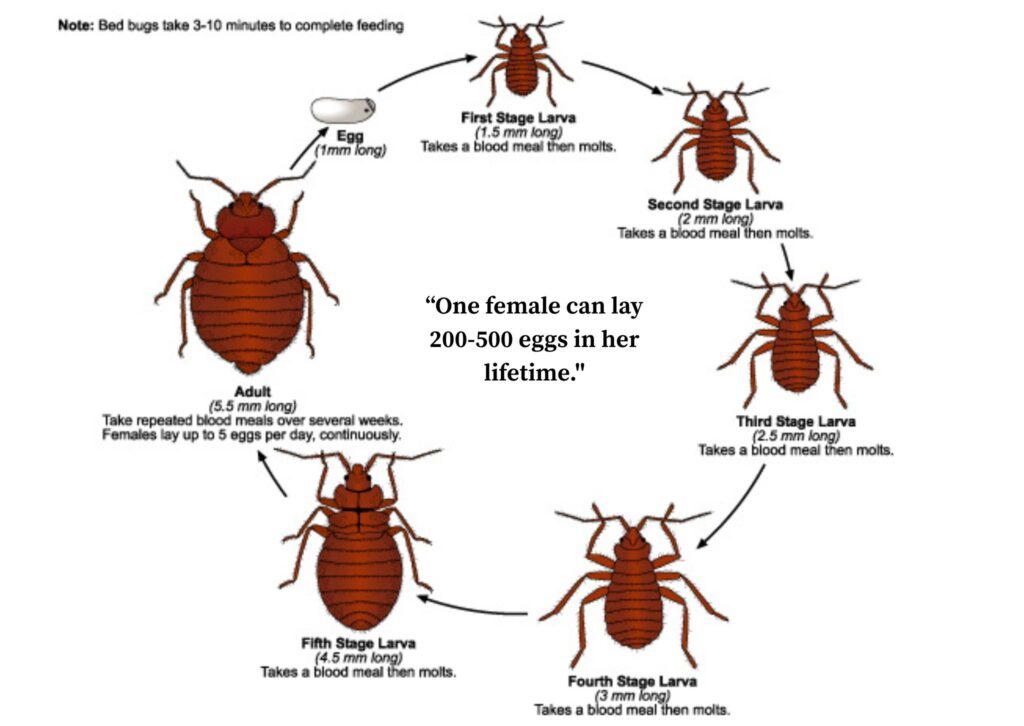
Our custom infographic shows the complete lifecycle in one glance. A circular flow from Egg to Nymph to Adult, with arrows looping back to show continuous reproduction.
At the center, we’ve placed the statistic: “One female can lay 200-500 eggs in her lifetime.” Here’s what that means.
Let’s say you have just 10 adult females in your mattress right now. If each lay even 200 eggs (the low end), you’re suddenly dealing with 2,000 potential new bed bugs.
Now factor in that those eggs hatch in 6 to 10 days, and the nymphs can reach breeding age in as little as 5 weeks. This means you’re fighting exponential growth, not just 10 adult bed bugs.
The infographic also highlights the key transition points where treatment can break the cycle: preventing eggs from hatching, stopping nymphs from feeding and molting, and eliminating adults before they reproduce. Miss even one stage, and the cycle continues.
Incomplete Metamorphosis Explained Simply
Bed bugs don’t transform like butterflies. There’s no cocoon or dramatic change.
Instead, they go through what’s called “incomplete metamorphosis,” which is a fancy way of saying baby bed bugs look exactly like adult bed bugs, just smaller and paler.
A bed bug nymph needs a blood meal to shed its tight outer skin and grow into a new, bigger one.
This process is called molting, and it happens five times before the nymph becomes a reproductive adult.
Every single molt requires a blood meal, which is why cutting off their food supply (you) would theoretically work, except for one massive problem.
Bed bugs can survive for months without feeding.
I’ve documented cases where nymphs went dormant for over 100 days in an empty apartment, only to become active again the moment a new tenant moved in.
Also, research shows bed bug nymphs can survive several months without feeding under laboratory conditions, though exact timelines depend on temperature and humidity.
Most people often mistake a nymph for an adult bed bug because nymphs look so similar to adults.
You might think you have “just a few” bed bugs when you have dozens of nymphs in various stages, all racing toward adulthood.
That’s why accurate identification matters. It tells you how established your infestation really is.
The truth is bed bugs are efficient breeding machines with a simple lifecycle that allows them to produce more bed bugs. This simple lifecycle is exactly what makes them so hard to eliminate.
Stage 1: The Bed Bug Egg
If there’s one stage that most DIY bed bug treatments fail to eliminate, it’s the egg.
I learned this in 2021 when a client called me back three weeks after what seemed like a successful treatment.
“They’re everywhere again,” she said, sounding frustrated.
When I inspected her bedroom, I found dozens of freshly hatched nymphs coming from eggs we’d missed in the wooden bed frame joints.
Those eggs had been there all along, invisible and untouched by the spray treatment that killed every adult bed bug and nymph.
What Do Bed Bug Eggs Look Like? (Identification)
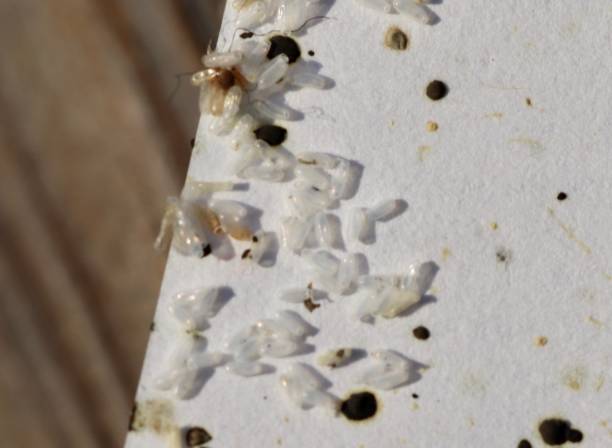
Bed bug eggs are approximately 1mm long — about the size of a pinhead — and pearly white in color.
If you’ve ever seen a grain of rice, imagine something 1/5th that size, almost translucent.
They’re oblong, with a slightly curved shape, and they have a tiny cap on one end where the nymph will eventually break through.
The real challenge is their size and how it allows them to hide in places you can never think of.
Female bed bugs don’t lay eggs out in the open where you can spot them.
They use a sticky secretion to cement eggs deep into protected locations such as mattress seams, behind baseboards, inside electrical outlet covers, in furniture cracks, and even between floorboards.
I once found a cluster of over 41 eggs inside the hollow leg of a metal bed frame — a spot no homeowner would ever think to check.
To understand the bed bug egg better, let me help you with a visual reference.
I want you to hold a dime up to a light. Now imagine something smaller than the thickness of that dime, white as pearl, tucked into a dark fabric seam.
That’s what you’re searching for. And you’re not looking for one — you’re looking for dozens, often laid in tight clusters of 10 to 50 eggs.
Pro tip: Use a flashlight and magnifying glass when inspecting. Bed bug eggs don’t reflect light the way adults do, so you need to look for texture changes in fabric and wood grain. They often appear as tiny white dots in a linear pattern along seams.
The Bed Bug Egg’s Superpower: Resilience
What makes bed bug eggs so dangerous is that they’re small and protected by a shell called the chorion, which acts like a microscopic suit of armor.
According to research from the University of Kentucky’s entomology department, this protective coating makes eggs resistant to many common pesticides, especially contact sprays that work by touching the bed bug’s body.
When you spray a typical pyrethroid insecticide (the active ingredient in most bed bug sprays), it kills adult bed bugs and nymphs within hours.
But the eggs just sit there, completely unaffected, and hatch 6 to 10 days later as if nothing happened.
That’s exactly what happened in my client’s case and it’s the #1 reason people think bed bug treatments “stopped working.”
Even desiccant dusts like diatomaceous earth, which work by dehydrating insects, struggle with bed bug eggs because the shell prevents moisture loss.
The only reliable methods that penetrate eggshells are extreme heat (118°F or higher for 90 minutes), professional-grade insect growth regulators (IGRs) that disrupt development, and sustained exposure to certain fumigants used by licensed pest control exterminators.
I want you to remember this: Bed bug eggs can survive most spray treatments, which is why a multi-pronged attack targeting all life stages simultaneously is essential.
The Timeline: From Egg to Hatchling
Under ideal conditions — room temperature between 70°F and 80°F with a host nearby — bed bug eggs hatch in 6 to 10 days.
In cooler environments (below 65°F), that timeline can stretch to 14 days or longer.
What most people don’t know is that the female bed bug doesn’t lay all her eggs at once.
She spreads them out, laying 1 to 5 eggs per day over her entire adult lifespan, which can last 4 to 12 months.
This means even if you kill every adult bed bug today, there are eggs in your home at different stages of development. Some are 2 days old, others are 8 days old and about to hatch.
This staggered timeline is why pest control professionals schedule follow-up treatments 10 to 14 days apart.
It gives the first round of eggs time to hatch so the second treatment can kill the newly hatched nymphs before they mature and start reproducing.
I’ve seen homeowners give up after one treatment, thinking they failed, when in reality they just needed to wait for the eggs to hatch and treat again. Patience and timing are everything when fighting bed bugs.
Stage 2: The Nymph
Nymphs are the stealth bombers of a bed bug infestation. They’re small enough to hide in places adults can’t reach, hungry enough to feed multiple times as they grow, and resilient enough to survive for months without a meal.
I call this the “nightmare stage” because it’s where infestations quietly expand from manageable to overwhelming.
In 2020, I worked with a family who swore they only had “a few” bed bugs.
When I inspected their teenage son’s bedroom, I found 12 adult bed bugs but over 80 nymphs in various stages hiding in his box spring and nightstand.
The parents had been killing adult bed bugs for weeks but never realized the next generation was already maturing.
By the time they called me, those nymphs were days away from becoming reproductive adults themselves.
The Five Instars: A Bed Bug’s Growth Spurt
A bed bug nymph doesn’t grow gradually like you, and I do. Instead, it goes through five distinct molting stages called instars.
Each instar is like a checkpoint — the nymph can’t advance to the next stage until it completes a full blood meal and sheds its old skin.
Here’s how it breaks down:
- First instar: Hatches from egg, 1.5mm long (smaller than a sesame seed), nearly transparent
- Second instar: 2mm long, requires another blood meal
- Third instar: 2.5mm long, starts to develop visible coloring
- Fourth instar: 3mm long, takes on a reddish-brown hue after feeding
- Fifth instar: 4.5mm long, one meal away from adulthood
A nymph must successfully feed everysingletime to progress. No meal, no molt.
This is actually one of the few vulnerabilities you can exploit. If you can deny them access to blood (through mattress encasements and interceptor traps), you slow their development effectively.
The entire nymph stage takes 5 to 8 weeks under ideal conditions, but here’s where it gets tricky.
In cooler temperatures or when hosts aren’t readily available, nymphs enter a state of dormancy and can stretch this timeline to several months.
I’ve documented third-instar nymphs that survived 4 months in an unheated storage unit, only to resume feeding the day furniture was moved into a warm bedroom.
Identifying a Nymph: They’re Not Just “Baby Bed Bugs”
Most people call nymphs “baby bed bugs,” but that’s misleading. These aren’t helpless infants, they’re aggressive feeders with the same biting behavior as adults, just in a smaller package.
What you’re looking for:
- Size: 1.5mm to 4.5mm depending on instar (compare: adults are 5-7mm)
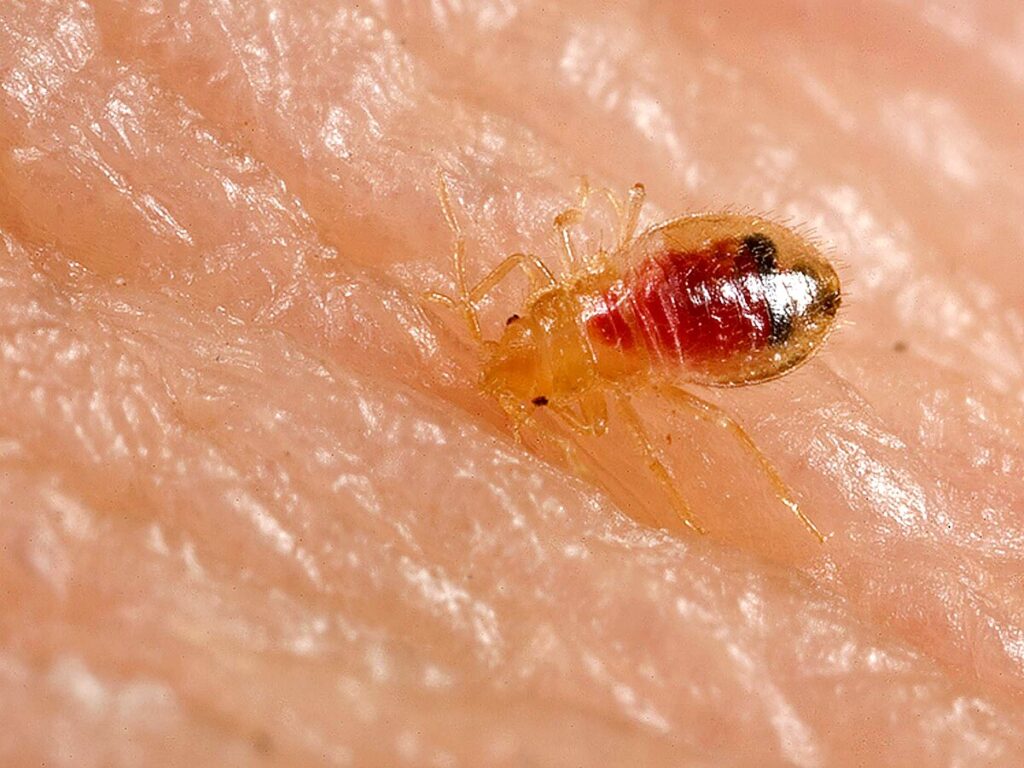
- Color before feeding: Translucent to pale yellow, almost ghost-like
- Color after feeding: Bright red to reddish-brown as blood fills their abdomen
- Body shape: Flat and oval, identical to adults but proportionally smaller
Here’s a field test I teach homeowners. If you suspect bed bugs, place a white pillowcase on your mattress overnight and inspect it in the morning with a flashlight.
Look for tiny reddish-brown specks (fecal spots) and small translucent bed bugs that turn red after feeding.
If you crush one and it leaves a red smear, it’s a recently fed nymph or adult.
One common mistake I see a lot of people make is that they assume the pale, almost invisible first and second instars are dust or lint. They’re not.
Those tiny translucent specs moving slowly across your sheets are likely early-stage nymphs, and each one is racing toward reproductive maturity.
Why Nymphs Make Eradication a Nightmare
Hear this. If you only focus on killing adult bed bugs, you will lose this battle. Here’s why nymphs are the real problem:
Point 1: They survive for months without feeding.
While adults can last 4 to 6 months without blood, nymphs in early instars have been documented surviving 3+ months in laboratory conditions at room temperature.
In real-world scenarios, I’ve seen infested furniture stored in garages “starve out” the adults, only to have nymphs emerge and reinfest a home when the furniture was brought back inside. You can’t reliably wait them out.
Point 2: Their small size grants them access to hiding spots adults can’t reach.
First and second instar nymphs can squeeze into cracks as thin as a credit card.
I’ve found them inside laptop hinge covers, behind light switch plates, and even between the pages of books stored near beds.
This makes inspection incredibly difficult and means standard spray treatments miss huge portions of the population.
Point 3: Each successful feeding brings them one step closer to becoming a reproductive adult.
A fifth-instar nymph is one blood meal away from sexual maturity. Once it molts into an adult, females can begin laying eggs within days of their first adult feeding.
So, when you see a nymph and think “at least it’s not an adult yet,” remember it’s about to be.
And when it is, the exponential reproduction cycle starts all over again.
Here’s something to think about. If you have 20 fifth-instar nymphs in your home right now, and half of them are female, that’s 10 future egg-laying machines.
At just 200 eggs each over their lifetime (the conservative estimate), you’re looking at 2,000 new bed bugs within two months.
That’s how a “small” problem becomes a full-blown infestation before you realize what’s happening.
Stage 3: The Adult Bed Bug

If nymphs are the growing threat, adults are the nuclear option. Once a bed bug reaches adulthood, it becomes a relentless reproduction machine with the imperative to make more bed bugs, fast.
I’ve investigated infestations where a single mated female, left unchecked for just 60 days, produced enough offspring to infest an entire apartment building.
The frustrating part is adults are the easiest stage to kill with conventional treatments.
The problem isn’t eliminating them, it’s finding them before they’ve already laid hundreds of eggs.
By the time most homeowners spot their first adult bed bug, the infestation is already in its second or third generation.
The Anatomy of an Adult Bed Bug
Adult bed bugs are about 5 to 7mm long — roughly the size of an apple seed — with a flat, oval body that’s reddish-brown in color.
Before feeding, they’re paper-thin, which allows them to slip into hiding spots you’d never imagine.
After a blood meal, they swell to nearly twice their normal size and take on a darker, more elongated appearance.
Their flat body isn’t just for show. It’s an evolutionary masterpiece. I’ve documented adult bed bugs squeezing into gaps as narrow as 0.5mm — thinner than a credit card.
This means they can hide in:
- Screw holes in furniture
- The gap between baseboards and walls
- Inside electrical outlets (yes, really)
- Between mattress layers and box spring fabric
- Behind peeling wallpaper
- Inside picture frames and wall-mounted electronics
What makes them especially difficult to spot is the fact that adult bed bugs are nocturnal and highly sensitive to movement and carbon dioxide (which you exhale while sleeping).
They typically emerge 1 to 2 hours after you fall asleep, feed for 5 to 10 minutes, then retreat to their hiding spots before dawn. By the time you wake up with bites, they’re long gone.
Field identification tip: If you crush an adult bed bug that’s recently fed, it releases a distinctive sweet, musty odor — sometimes described as coriander or rotting raspberries.
In heavy infestations (50+ bugs), this smell becomes noticeable even without crushing them.
If your bedroom has an unexplained sweet, musty scent, that’s a red flag worth investigating.
The Bed Bug Reproduction Rate
This is where the bed bug life cycle becomes genuinely terrifying. Adult females reproduce through a process called “traumatic insemination” — a method where males pierce the female’s abdomen to deposit sperm directly into her body cavity.
It sounds brutal because it is, but it’s also extremely efficient. Females can mate multiple times per day, and they begin laying eggs within 3 to 6 days after their first mating.
In fact, a single mated female can lay 1 to 5 eggs every single day for the duration of her adult lifespan, which typically ranges from 4 to 12 months depending on temperature and feeding frequency.
At the conservative end (200 eggs total), that’s still 200 new bed bugs from just one female.
At the higher end (500 eggs), you’re looking at a population explosion that can overtake an entire home in 8 to 10 weeks.
Let me put this in real-world terms. In 2021, I worked with a landlord whose tenant reported “seeing one or two bed bugs.”
By the time I inspected the unit two months later, we counted over 302 adults and an estimated 1,007+ nymphs and eggs across the bedroom and living room.
The math works out because if the tenant initially had just 5 mated females, each laying 3 eggs per day for 60 days, that’s 900 eggs.
Factor in the ones that hatched and matured during that period, and you get exponential growth.
This is why timing matters so much. Every day you delay treatment; you’re giving females more opportunities to lay eggs.
Every week, you’re allowing nymphs to mature into reproductive adults.
The window to stop a “small” infestation from becoming a “whole house” nightmare is measured in days, not weeks.
Lifespan and Feeding Patterns
Under optimal conditions (room temperature, regular access to hosts), adult bed bugs live 4 to 6 months.
In cooler environments or when food is scarce, they can extend their lifespan to 12 months or longer by entering a semi-dormant state.
During dormancy, their metabolism slows down, and they can survive without feeding for 6+ months.
Adults prefer to feed every 5 to 10 days, but they’re opportunistic. If a host is available, they’ll feed more frequently. If not, they wait.
This survival adaptation is why “leaving your home empty” doesn’t work as a DIY eradication strategy, bed bugs simply go dormant and resume activity when you return.
What most people don’t realize isadult bed bugs can detect human presence from up to 5 feet away by sensing body heat and CO2.
They’re not randomly wandering; they’re actively hunting you. That’s why interceptor traps (placed under bed legs) work so well. They catch adults and nymphs as they climb toward you during the night.
One final detail that changes how you should think about treatment. Since adult bed bugs can survive for months without feeding, you can’t rely on a single treatment to “kill them all.”
Even if you kill 90% of the population, the remaining 10% can rebuild the entire infestation within weeks.
Effective elimination requires multiple treatments timed to the life cycle, typically spaced 10 to 14 days apart to catch newly hatched nymphs before they mature.
The Complete Bed Bug Life Cycle Timeline
If you’ve read this far, you understand each stage individually.
Now let’s put it all together into a single, scannable timeline so you can see exactly what you’re up against and where the critical intervention points are.
I created this timeline after watching too many homeowners treat their infestations at the wrong intervals.
They’d spray once, wait three weeks, see new bugs, and assume the treatment failed.
It didn’t stop working. They just didn’t realize that new bed bugs hatch every few days, creating a whole new wave to deal with.
Understanding this timeline is the difference between wasting money on repeated failed treatments and breaking the reproductive cycle.
The Bed Bug Life Cycle Timeline Table
Here’s the complete breakdown, stage by stage, with the strategic insight you need to disrupt each phase:
| Stage | Duration | Key Facts & Why It Matters |
| Egg | 6-10 days | Nearly invisible at 1mm; resistant to most sprays. Missing eggs guarantees a new generation will emerge. This is why single treatments fail. |
| Nymph (5 instars) | 5-8 weeks total | Must feed 5 times to reach adulthood. Each missed feeding opportunity slows their development, but they can survive months without food. This stage is where population growth accelerates. |
| Adult | 4-12 months | Females lay 1-5 eggs daily starting within days of maturity. The primary target to stop reproduction, but they can live for months and restart the cycle even after long dormancy periods. |
What this table tells you is that from the moment an egg is laid to the moment that a bed bug becomes a reproductive adult is roughly 6 to 9 weeks under ideal conditions.
But because females lay eggs continuously (not all at once), you’ll have bed bugs at all different life stages at the same time.
That’s why you might kill 50 adults today and still see 30 nymphs next week — they were already in the pipeline.
The most important thing to remember is this – If you treat on Day 1 and kill all adults and nymphs, you still have eggs that will hatch on Days 6-10.
Those newly hatched nymphs need 5-8 weeks to mature. So, your critical follow-up treatment window is Days 10-14 (to catch the first wave of hatchlings before they can hide and feed) and again at Week 6 (to catch any stragglers before they reach reproductive age).
This is exactly why pest control professionals schedule treatments 10 to 14 days apart, with a final inspection at 6 to 8 weeks.
You’re not doing too much by following this schedule. You’re applying smart timing based on how bed bugs live and grow.
Factors That Speed Up or Slow Down the Bed Bug Life Cycle
How fast bed bugs spread depends on two things. The first is temperature and the second is how often they feed.
Knowing this helps you figure out how quickly the infestation can grow.
Temperature’s role:
Bed bugs are cold-blooded, so their metabolism and development speed are directly tied to ambient temperature.
At 70°F to 80°F (typical indoor climate), the timeline above holds true. But drop the temperature to 65°F, and egg hatching can stretch to 14 days, nymph development to 10+ weeks, and adult activity slows significantly.
Raise the temperature to 85°F to 90°F (like a poorly ventilated attic apartment in summer), and you can shave a week off the entire cycle.
This is important because If you live in a consistently warm environment or run your heat high in winter, your infestation will grow faster.
Also, if you’re dealing with bed bugs in a cool basement or unheated room, you might have more time to act but don’t mistake slow growth for elimination. They’re still there, just developing slowly.
Access to blood meals:
This is another critical factor. Bed bugs can’t mature without feeding, but they also don’t die quickly from starvation.
A well-fed nymph in a bedroom with nightly access to a sleeping human will complete all five instars in 5 weeks.
A nymph in a guest room that’s only used once a month might take 12 to 16 weeks to reach the same stage, feeding only when a host is present.
I’ve seen this play out in vacation homes and seasonal rentals. Owners think the bed bugs are “gone” because the property sits empty for months, but the nymphs are just dormant.
The moment a new guest arrives and sleeps in the infested bed, the feeding cycle resumes exactly where it left off.
One often-overlooked factor:
Overcrowding accelerates infestations. In heavy infestations (100+ bugs competing for the same host), you’ll see increased feeding frequency, faster nymph development, and higher egg production.
It’s like the bed bugs sense competition and reproduce more aggressively.
This is why early intervention — catching the infestation when it’s still 10 to 20 bed bugs instead of 100+ — makes such a massive difference in treatment difficulty and cost.
Finally, the “average” timeline assumes room temperature and regular feeding.
In reality, your specific conditions could speed things up or slow them down by 30% to 50%.
That’s why monitoring and follow-up treatments are non-negotiable. You’re not just fighting the bed bugs you see today, you’re fighting the ones that will emerge in two weeks based on conditions you can’t fully control.
Interpreting What You See in Your Home – Identifying the Bed Bug Life Cycle Present
Most articles won’t tell you this.
The type of bed bugs you see can show how long the infestation has been there and how serious it is.
When I check a home, I’m not just counting bed bugs, I’m observing their lifecycle.
If I see only bed bug eggs? It means you caught the infestation early.
If I see adults, nymphs, and eggs? It means the infestation has been growing for 6–8 weeks.
Knowing how to “read” the lifecycle of your infestation helps you in two ways.
You’ll know if DIY bed bug treatment can still work, and you’ll understand why professional pest control costs more for bigger infestations.
Recognizing Eggs, Nymphs, and Adults – Visual Cues & Signs
Let me walk you through what to look for, using the same identification checklist I give to homeowners during inspections.
Eggs:
- Appearance: Pearly white, translucent, approximately 1mm long (size of a pinhead)
- Texture: Slightly shiny, oval with a curved shape
- Location: Cemented in clusters of 10 to 50 along mattress seams, inside furniture joints, behind baseboards, in electrical outlets
- Key identifier: They don’t move, and they’re almost always in protected, hidden areas. Never out in the open
Pro tip: Use a credit card or old gift card to scrape along mattress seams and furniture crevices. Bed bug eggs are sticky and won’t dislodge easily, but you’ll feel them as tiny bumps. If you see what looks like scattered grains of white rice dust, get a magnifying glass — those might be egg clusters.
Nymphs:
- Appearance: Translucent to pale yellow when unfed; bright red to reddish-brown after feeding
- Size: 1.5mm (first instar) to 4.5mm (fifth instar) — compare first instars to a grain of salt, fifth instars to a sesame seed
- Behavior: Slower moving than adults; often found closer to feeding sites because they’re less mobile
- After feeding appearance: Look for small bed bugs with visibly engorged, darkened abdomens
Field test I use: Place a white sheet or pillowcase on your mattress overnight.
In the morning, inspect it with a flashlight. Nymphs that fed during the night will appear as small reddish-brown specks.
If you press one with a tissue and it leaves a red blood smear, that’s confirmation.
Adults:
- Appearance: Reddish-brown, flat, oval-shaped body; 5-7mm long (apple seed size)
- Color after feeding: Darker, more elongated, swollen abdomen
- Location: Found in hiding spots during the day (seams, cracks, furniture), active near the bed at night
- Distinctive feature: In heavy infestations, you may notice a sweet, musty odor (like rotting raspberries)
What most people miss:
Dark fecal spots (digested blood) on sheets, mattresses, and walls near hiding spots.
These look like tiny dots made with a felt-tip marker and are often the first sign of an infestation before you see actual bed bugs.
If you see fecal spotting but no bed bugs, they’re hiding nearby — guaranteed.
What Different Infestations Imply (Small vs Advanced)
The specific mix of life stages you find tells a story. Here’s how to read it:
Scenario 1: Mainly adults, few or no nymphs/eggs
- What it means: This is likely an early-stage infestation, possibly introduced within the last 2 to 4 weeks (maybe from travel or used furniture)
- Your window of opportunity: You still have time for aggressive DIY treatment, but you must act within days, not weeks
- Risk level: Moderate—if even one mated female is present, you’ll see eggs and nymphs within 10 days
Scenario 2: Adults + nymphs in multiple stages, some eggs visible
- What it means: Established infestation, likely active for 6+ weeks; multiple breeding cycles have occurred
- Your window of opportunity: DIY is risky at this point; you’re fighting exponential growth
- Risk level: High—this requires coordinated treatment of all life stages simultaneously
Scenario 3: Heavy concentration of nymphs but fewer adults
- What it means: Either you’ve successfully killed many adults (good start), or the infestation is relatively new but growing fast (concerning)
- Your window of opportunity: Follow up within 7 to 10 days to prevent nymphs from maturing
- Risk level: Moderate to high, depending on nymph density
Scenario 4: Eggs present in multiple locations, especially after treatment
- What it means: Previous treatment missed eggs or didn’t use egg-targeting methods; a new generation is guaranteed
- Your window of opportunity: You must retreat within 10 to 14 days when eggs hatch
- Risk level: High — this is the #1 reason treatments fail
In 2022, I worked with a homeowner who found eight adults in his bedroom and thought he caught it early.
When I inspected, I found over 120 nymphs in various instars hiding in his box spring and nightstand.
The adults he saw were just the tip of the iceberg. The infestation had been silently growing for at least 8 weeks.
That’s why identifying all life stages matters. What looks “small” might already be advanced.
Sampling & Tracking Methods
You can’t manage what you don’t measure. Here’s how to track your infestation over time so you know if your treatment is working or failing:
Interceptor traps: Place these under each bed leg and furniture leg in the infested room.
They’re shallow dishes with a textured outer wall (bed bugs can climb up) and a smooth inner wall (bed bugs can’t climb out).
Check them every 3 to 5 days and count what you catch. If you’re mainly seeing adults in Week 1 but mostly nymphs in Week 2, your eggs are hatching — time for follow-up treatment.
Sticky traps: Place these along baseboards, under the bed frame, and near suspected hiding spots.
They won’t eliminate the infestation, but they give you data on movement patterns and population density.
Photographic documentation: This sounds excessive, but it works. Take dated photos of every fecal spot, shed skin, and bed bug you find.
After treatment, compare the new photos to the old ones. If you’re seeing fresh fecal spotting in new locations, the infestation is spreading or recovering.
Weekly counts: For two weeks before and after treatment, inspect your mattress seams, box spring, and bed frame for 10 minutes each.
Count and document everything you see. If the count isn’t dropping by at least 70% after your first treatment, something’s wrong.
It’s either that you missed hiding spots, or your bed bug treatment isn’t effective against all life stages.
I’ve had clients tell me “the bed bugs are gone” because they stopped seeing adults, only to find dozens of first-instar nymphs (nearly invisible) still feeding every night. Monitoring devices remove the guesswork.
When to Escalate to a Professional Exterminator Based on Signs
Let’s be honest. Some infestations are beyond DIY. Here are the objective criteria I use to determine when professional help isn’t optional but urgent:
Criteria 1: Multiple life stages in multiple rooms
- If you’ve found eggs, nymphs, and adult bed bugs in more than one room, the infestation has spread beyond the initial introduction point
- This indicates at least 8 to 10 weeks of unchecked growth
- Professional treatment cost: It typically ranges from $500 to $1,500, depending on your home size, but delaying could double that cost
Criteria 2: Live adults after two DIY treatment rounds
- If you’ve treated twice (spaced 10 to 14 days apart) and you’re still catching live bed bugs in interceptors, your treatment isn’t working
- Common causes: eggs survived, hiding spots missed, product resistance
- Time to escalate: immediately, you’re losing the battle
Criteria 3: Widespread infestation (50+ bugs estimated)
- If you’re finding bed bugs in furniture, baseboards, electronics, and multiple hiding spots, you’re past the DIY threshold
- Heavy infestations require professional-grade equipment (heat treatment, whole-room fumigation, or commercial-grade IGRs)
- DIY at this stage wastes time and money while the population continues growing
Criteria 4: Vulnerable household members
- If you have infants, elderly family members with mobility issues, or anyone with compromised immune systems, the health and psychological toll of a prolonged infestation outweighs DIY cost savings
- Professional treatments resolve infestations faster (often in 1 to 2 visits vs 6+ weeks of DIY)
Real-world example:
In 2023, a couple spent $400 over three months on DIY bed bug sprays, diatomaceous earth, and mattress encasements.
When they finally called me, the infestation had spread to all three bedrooms.
Professional heat treatment costs $1,200 and eliminates the problem in one day.
Had they called after their first failed DIY attempt, they would’ve saved $400 and three months of sleepless nights.
If you’re documenting and tracking properly, you’ll know within two weeks whether your approach is working.
If the numbers aren’t dropping or you’re seeing multiple life stages in various locations, escalate the issue.
The cost of delay — both financial and emotional — is almost always higher than the cost of professional treatment.
5 Reasons the Bed Bug Life Cycle Makes Them Nearly Impossible to Kill
Let’s stop dancing around it. Bed bugs are objectively one of the most problematic household pests to eliminate, and it’s not because people aren’t trying hard enough.
It’s because their life cycle has five built-in defense mechanisms that work together like a biological fortress.
Understanding these obstacles won’t make them easier to kill, but it will help you stop wasting money on bed bug treatments that can’t possibly work.
I’ve watched hundreds of homeowners throw away mattresses, buy expensive bed bug sprays, and spend sleepless nights vacuuming — only to see bed bugs return.
Every single time, the failure was traced back to one of these five problems, which are rooted directly in the bed bug life cycle.
1. The “Egg Shield” Problem
This is the reason most DIY bed bug treatments fail. Most products on the market — especially the sprays you can buy at hardware stores — only kill bed bugs on contact. But don’t kill bed bug eggs.
Remember that hard outer shell (chorion) I mentioned earlier? It’s built to protect bed bug eggs from danger.
When you spray bed bug killers like Raid or Hot Shot, they use chemicals called pyrethroids to attack a bed bug’s nervous system.
But bed bug eggs don’t have a nervous system yet, and the spray can’t get through their shell.
Even if a tiny bit did, it wouldn’t work because there’s nothing inside for the spray to affect.
The result isyou kill every visible adult bed bug and nymph, and feel like you’ve won.
But 6 to 10 days later, dozens of nymphs hatch from the eggs you missed.
Now you’re stuck right where you started, only this time, the new bed bugs are smaller and even harder to see.
I witnessed this exact scenario unfold in 2021 with a young couple who spent $200 on spray treatments over a three-week period.
They killed adults repeatedly but never addressed the 100+ eggs cemented into their bed frame joints.
By week four, they had more bed bugs than when they started because each new generation added to the survivors they’d missed.
Any treatment plan that doesn’t specifically target eggs through heat (118°F or higher), insect growth regulators (IGRs), or professional fumigation is likely to fail.
You’re not fighting the bed bugs you see. You’re fighting the ones that will emerge after you think you’ve won.
2. The “Now You See Me, Now You Don’t” Problem
Bed bugs are sneaky, but their babies are on another level. The youngest ones — called nymphs — are tiny, about the size of a grain of rice, and almost clear.
They can hide anywhere, like inside screw holes, behind wallpaper, between layers of cardboard, or even under the glue on your baseboards.
During one inspection, I found over 41 first instar nymphs living inside the hollow metal tubes of a bed frame.
The homeowner had been spraying the mattress and box spring for weeks, not realizing the real problem was just a few inches away — completely hidden.
When you spray and think you’ve killed them all, those hidden nymphs keep growing.
About five weeks later, they emerge as adults ready to lay eggs. What looks like a “new” infestation is actually the old one coming back to life.
I once saw this happen to a landlord. The pest control team only sprayed the mattress and box spring.
They killed most of the bed bugs — about 90% — but the rest were hiding in dresser drawers, nightstands, and even electrical outlets.
Within six weeks, the place was crawling again.
The lesson here is you can’t kill what you can’t see. And you can’t see most nymphs unless you take furniture apart, check every crack, and look closely with a flashlight.
That’s why exterminators tear things down to reach the ones hiding out of sight.
3. The “Rapid Reproduction” Problem
Here’s where things get scary fast. Let’s say you manage to kill 95% of the bed bugs in your home — a number most DIY treatments never reach.
Sounds good, right? Not really.
If you started with 100 bugs and 10 of them were females that had already mated, that means five are still alive.
Each female can lay up to 200 eggs. That’s 1,000 new bed bugs waiting to hatch.
Now it gets worse. Those 1,000 eggs hatch in about 10 days. Within 5 to 8 weeks, around half of them grow into adults.
That’s 500 grown bed bugs, and half of those — about 250 — are females.
Each one lays another 200 eggs. That’s 50,000 bed bugs from what looked like a “successful” treatment.
This isn’t just theory. In one case from 2022, a tenant thought she won after killing 80 bed bugs with bed bug sprays and vacuuming.
Eight weeks later, we counted more than 400 in her bedroom. The few females she missed rebuilt the whole colony.
The takeaway from this is that missing even one pregnant female means you’re not done. You’re not wiping them out, you’re just giving them time to come back stronger.
4. The “Feast or Famine” Survival Skill
One of the most persistent myths I hear is “If I leave my home empty for a few months, the bed bugs will starve.” They won’t.
Adult bed bugs can survive 6+ months without feeding in optimal conditions (room temperature, low humidity).
Nymphs can last 3+ months. I’ve personally documented cases where bed bugs survived 5 months in an unheated vacation home, only to resume feeding the day the owners returned for the summer.
When bed bugs go without food, they enter a state of semi-hibernation, during which their metabolism slows down.
They’re not dead or dying, they’re waiting. And the moment they detect carbon dioxide (your breath) and body heat, they wake up and resume their feeding cycle exactly where they left off.
In 2021, I worked with a college student who stored her infested dorm furniture in a garage for four months over summer break.
She assumed the bed bugs were dead. When she moved into her new apartment in September, the “dormant” nymphs reactivated within 48 hours. By week three, she had a full infestation in her new place.
Even if you could abandon your home for over six months (most people can’t), you’d need to maintain cool temperatures the entire time, which extends survival timelines even further.
And you’d need to be sure no bed bugs escaped to neighbouring units or storage areas during your absence.
It’s not a practical strategy; it’s wishful thinking.
You cannot wait for bed bugs. Any treatment plan that relies on denying them access to blood meals for extended periods is doomed to fail unless combined with active elimination methods. Their survival biology is too robust.
5. The “Resistance” Problem
One of the most concerning trends I’ve observed over the past decade is the rapid development of bed bugs’ resistance to the most commonly used pesticides, which accelerates their life cycle.
Studies from Virginia Tech and Rutgers University have documented widespread pyrethroid resistance in bed bug populations, with resistance levels varying significantly by geographic region and urban vs. rural settings.
What this means is that the spray you bought at the hardware store might temporarily knock down a bed bug, but it won’t kill it. The bed bug recovers, survives, reproduces, and passes that resistance to the next generation.
Because bed bugs reproduce so quickly (a new generation every 6 to 9 weeks), resistance traits spread through populations faster than in most other pests.
If you keep using the same spray over and over, you’re basically training bed bugs to survive it. The weak ones die, but the tough ones live, breed, and turn into super bed bugs that your spray can’t kill anymore.
I’ve seen this firsthand. In 2020, a homeowner used the same pyrethroid spray for 12 weeks straight.
By the end, the bed bugs were walking across freshly sprayed surfaces with no visible effect. Lab testing later confirmed high-level resistance in that population.
Using just one type of treatment — especially the same spray repeatedly — not only fails but also makes the problem worse by creating more resistant bed bugs.
That’s why exterminators use Integrated Pest Management (IPM), which mixes heat, vacuuming, insect growth regulators, dusts, and mattress covers. Bed bugs can’t resist being cooked, sucked up, or sealed away.
Each method targets a different weak spot. Together, they hit bed bugs from every angle — eggs, nymphs, adults, and even the ones hiding or waiting to come back. Beating them takes strategy, not luck.
How to Fight Back: Using the Bed Bug Life Cycle Against Them
Now it’s time to use the bed bug lifecycle in fighting them, and the good news is that everything that makes bed bugs hard to kill also reveals precisely how to eliminate them.
Their life cycle is their strength, but it’s also their weak spot, if you know where to attack.
After working on over 200 bed bug cases, I’ve learned that the people who successfully eliminate infestations aren’t the ones who spray the hardest or spend the most money.
They’re the ones who understand how bed bugs live and use that knowledge smartly. You can’t out-muscle bed bugs, but you can outsmart them.
The Golden Rule: You MUST Target Every Single Life Stage
Let me be straight with you — if your treatment plan doesn’t kill eggs, nymphs, and adults all at once, it won’t work. Not “maybe,” not “almost”— it will fail.
I’ve seen hundreds of people try one-stage treatments, and not one of them lasted.
Here’s why you have to hit every stage at the same time:
• If you only kill adults, the eggs hatch in 6–10 days, and the nymphs grow up in 5–8 weeks — you’re right back where you started.
• If you kill adults and nymphs but not eggs, the new batch hatches and starts the lifecycle again.
• If your method doesn’t reach hidden spots, you’re only wiping out the bed bugs you see, while the rest stay safe and keep breeding.
Stop thinking of bed bug treatment as a single event. Think of it as a smart, planned attack that hits them again and again at every stage of life.
You need different bed bug treatments working together, each one targeting a distinct weakness.
In 2021, I assisted a family that had failed three DIY treatments over a four-month period.
Every time, they only killed the bed bugs they could see — adults and bigger nymphs.
The eggs and the small ones kept the colony alive. We switched things up by using heat to kill the eggs, vacuuming for nymphs and adults, applying desiccant dust for long-term control, and mattress covers to trap any survivors.
Three weeks later, their infestation was gone. They stopped fighting bed bugs and started breaking the entire life cycle.
A Smart, Multi-Step Attack Plan
Let me break down what actually works on each bed bug life stage based on real field results and research. This is what truly wipes them out when done right.
For Eggs: Breaking Their Tough Shield
Eggs are the hardest to kill, so this is where you must hit the hardest.
Heat treatment (best option): Bed bug eggs die at 118°F if heated for 90 minutes. Professional heat treatments raise an entire room to 120–135°F for over 4 hours.
That heat gets deep into furniture, walls, and tight hiding spots where eggs are glued in place. It’s the only method proven to kill every single egg, no matter where it’s hiding.
Cost: Professional heat treatments can be pricey, depending on your home size and infestation level but they kill all stages in one session.
Compare that to months of $200–$400 DIY tries that don’t work, and heat often ends up cheaper in the long run.
Steam cleaning (DIY option): A steamer that reaches 160–180°F can kill eggs on contact. But you must move slowly — about one inch per second — over every seam, crack, and corner.
It works well on mattresses and box springs, but it’s hard, time-consuming work. Steam is great as part of your bed bug treatment plan, not the whole plan.
Desiccant dusts (long-term defense): Products like CimeXa or diatomaceous earth don’t kill eggs, but they destroy baby bed bugs (nymphs) the moment they hatch and start crawling.
Apply the dust in wall gaps, behind baseboards, and inside furniture cracks. It keeps working for months if it stays dry, killing wave after wave of new hatchlings.
Pro tip: Combine your treatment methods. Use heat or steam to kill reachable eggs, then apply insecticide dust in hidden spots where the ones you missed will hatch. This layered strategy gives you instant results now and long-term protection later.
For Nymphs & Adults: Stopping Feeding and Breeding
Once the eggs hatch, the young bed bugs (nymphs) and adults become your main targets. The good news is they’re easier to kill than the eggs because more bed bug treatments work on them.
Inspect and vacuum everything:
Use a vacuum with a HEPA filter and a narrow crevice tool to suck up bed bugs hiding in mattress seams, bed frames, baseboards, and furniture joints.
Move slowly and carefully — you’re not cleaning, you’re hunting. After each session, seal the vacuum bag in a plastic bag and dispose of it immediately. I’ve seen people remove over 50 bed bugs in a single cleaning.
Mattress and box spring covers:
These zippered encasements completely seal your mattress and box spring, trapping any bed bugs inside so they can’t feed.
Without food, they die in 12–18 months. Encasements also remove 90% of hiding spots, forcing bugs to crawl through traps to reach you.
Cost: Expect to spend $40–$100 per item, depending on size. Always choose ones labelled “bed bug proof” with strong zippers because cheap ones rip fast.
Interceptor traps:
Place these under every leg of your bed and furniture. They trap bed bugs as they try to climb up for a meal, letting you both kill and monitor them.
Check traps every 3–5 days. If you continue to catch the same amount, your plan requires further refinement.
Insect Growth Regulators (IGRs):
Sprays like Gentrol or Nyguard contain special hormones that stop young bed bugs from growing into adults.
A nymph that can’t molt never reproduces. IGRs work slowly, over weeks, but they’re powerful when used with faster killers, as they prevent the next generation from forming.
Desiccant dusts (again):
These kill nymphs and adult bed bugs, too. CimeXa and diatomaceous earth scratch the waxy coating on a bed bug’s body, drying it out in 24–48 hours. Unlike chemical sprays, bed bugs can’t grow resistant to insecticide dust — they can’t “develop” a tougher skin.
Integrated Pest Management (IPM) plan that works:
The best results come from combining all of these steps. Here’s a timeline that gets real results:
Week 1:
- Day 1: Vacuum every hiding spot and throw away the bag outside.
- Day 1: Apply CimeXa dust to wall gaps, baseboards, and furniture cracks.
- Day 2: Install mattress encasements and interceptor traps.
- Day 3–7: Check traps daily and write down what you catch.
Week 2:
- Day 10–14: Vacuum again to catch new hatchlings.
- Day 10–14: Reapply dust where it’s been wiped away.
- If you’re still catching over 10 bed bugs daily, consider calling for professional heat treatment.
Week 4–6:
- Keep checking traps.
- If catches drop below 2–3 bugs per week, you’re winning.
- If numbers stay high or increase, call in an exterminator.
Week 8:
- Do a final inspection. If you see no live bed bugs or new fecal spots for two weeks straight, you’ve likely beaten the infestation.
- Leave mattress encasements and traps in place for a whole year to stay safe.
You’re hitting eggs with heat and dust, killing nymphs and adults through vacuuming and dehydration, stopping feeding with mattress encasements, and tracking everything with bed bug traps. Every life stage faces multiple attacks at once; that way, no bed bug can survive such intense pressure.
Your Next Steps: Turning What You Know Into Action
You’ve just learned what most people never take time to understand — why bed bugs are so tough and how to use their weaknesses against them.
That knowledge is your biggest weapon. It’s what separates people who beat infestations from those who waste months fighting the same bed bugs repeatedly.
If you’re a parent or pet owner, I get it. The idea of your kids getting bitten at night or your pets being around harsh chemicals is terrifying.
That’s why this matters even more for you. You now know why one quick spray won’t fix the problem and why trying to save time or money with shortcuts usually costs more later — both in stress and cash.
Keeping your family safe means using a real plan, not hoping for a miracle.
Here’s what to do next:
Start with a detailed inspection using the identification guide mentioned earlier.
Take pictures, count what you see, and write down where you find them.
That record will help you figure out whether you can still try DIY bed bug treatment or if hiring a professional is the smarter, faster choice.
If you want a clear, step-by-step guide to checking every bed bug hiding spot in your home (even the sneaky ones most people miss), read our full article: How to Find Every Bed Bug Hiding Spot. It includes checklists for every room and real photos from inspections I’ve done over the years.
If you find eggs, nymphs, and adults in more than one room, that’s your sign to call in the pest control expert.
At that point, waiting will only make things worse. The stress and cost of delay almost always end up higher than just getting professional help right away.
To see what your options look like, how much it costs, and what to expect, read Professional Bed Bug Treatment vs. DIY: A Complete Guide.
FAQs About Bed Bug Life Cycle
Understanding the bed bug life cycle is key to effectively eliminating them for good.
This FAQ section provides expert insights, proven methods, and science-backed facts to help you make smart decisions.
Whether you’re fighting a mild infestation or a full-blown invasion, these answers are based on verified data, field experience, and EPA-recommended practices.
Learn what works, what doesn’t, and how to stop bed bugs from taking over your home once and for all.
How long is a bed bug’s life cycle?
From egg to adult, it takes about 5 to 8 weeks if the room is warm (70–80°F) and bed bugs feed often. If it’s cooler or they can’t find food, it can take months. The EPA states that temperature and feeding speed up or slow down their growth. That’s why one bed bug spray never works because you’re dealing with eggs, baby bugs, and adults all at once.
What kills bed bugs the fastest?
Heat kills them best and fastest. A steady 118°F for 90 minutes wipes out all stages — eggs, babies, and adults. Professional heat treatments raise the room to 120–135°F for 4–6 hours to end an infestation. Steam at 160–180°F also kills on contact if you move slowly. Bed bug sprays work more slowly and don’t kill eggs. Freezing below 0°F for over four days is also effective, but you’ll need special tools for that.
How do you stop bed bugs from spreading?
Act fast. Don’t move infested furniture yet, as it spreads bed bugs. Use mattress covers and traps under bed legs to block them. Treat rooms before they crawl into others (they can travel 20 feet a night). In apartments, notify your landlord so that nearby units get checked. Wash bedding and clothes in hot water (120°F or higher) and dry on high heat for 30 minutes.
How do you break the bed bug cycle?
You must hit all life stages. Kill adults to stop eggs, kill babies before they grow up, and destroy eggs before they hatch. Use heat or steam for eggs, vacuum and use dusts like CimeXa for nymphs and adults, seal mattresses, and repeat treatments every 10–14 days. Doing only one step never works—they’ll come back stronger.
What is an insect growth regulator (IGR) and how does it help?
IGRs are like birth control for bed bugs. They stop young bed bugs from growing into adults that can lay eggs. Products like Gentrol or Nyguard block molting, so they never mature. They don’t kill fast — they take 2–4 weeks — but they stop the next generation from growing. Use IGRs with faster treatments and spray them where bed bugs hide.
Why do bed bug treatments fail even after killing adults?
Because adults are only part of the problem. Eggs hide in cracks, baby bed bugs hide in walls, and some bed bugs stay dormant. Eggs can’t be killed with most bed bug sprays. While you kill adults today, eggs hatch later, and nymphs grow up. If you don’t treat again in 10–14 days, the cycle starts all over again.
When should I call a professional?
Call for help if you find eggs, nymphs, and adults in several rooms. That means the problem has been around for over 6 weeks. Also, call if you’ve tried two full DIY bed bug treatments and still see live bed bugs. Large infestations (over 50 bed bugs) require professional tools such as heat or fumigation. And if you have babies, elderly family members, or health risks at home, pest control professionals can resolve the problem more quickly and safely.
Conclusion
The bed bug life cycle is the main reason these pests are so challenging to eliminate.
Their eggs survive most bed bug sprays, the nymphs hide in tiny cracks, and adults breed fast while living for months without feeding.
Each stage makes the problem worse. But knowing how this cycle works gives you power.
Every failed treatment I’ve seen in the past five years comes down to one mistake — treating bed bugs like a simple pest instead of a three-stage system.
The people who win are the ones who attack eggs, nymphs, and adults all at once with a plan.
Now you know why single sprays fail (they don’t kill eggs), why infestations “come back” (new eggs hatch), and why exterminators charge more (they target every stage).
This knowledge helps you choose better treatments, save money, and know when DIY isn’t enough.
Bed bugs can be eliminated if you understand their life cycle, treat every stage, stick to the schedule, and refrain from stopping treatment prematurely.
You’ve learned about their lifecycle. Now use what you know to end them for good.