Let me ask you a question.
What if I told you the bed bugs you can see aren’t your biggest problem?
The real danger is the ones you can’t see. The ones that are hiding, waiting to hatch and turn your life into a nightmare.
I’m talking about bed bug eggs.
These tiny, hidden time bombs are why most people lose the fight against bed bugs.
You can spray and kill every bed bug you see, but if you miss their secret egg clusters, you’ve already lost.
In just a week, a new army will hatch, and the nightmare starts all over again.
It’s a vicious breeding cycle that can make you feel helpless.
But what if you could find their secret hiding spots? What if you could spot their pearl-white shells before they have a chance to hatch?
My friend, that is how you win this war.
Not by fighting the same bed bugs over and over, but by stopping the next generation before it’s born. This is the ultimate form of early intervention.
In the next few minutes, I’m going to give you a battle plan.
I’ll show you exactly where a female bed bug hides her eggs, how to identify them (they’re sneaky), and the simple, surefire way to destroy every last one.
You don’t need an exterminator for this. You just need a flashlight, a good eye, and the knowledge I’m about to give you.
Ready to end the bed bug life cycle for good?
We independently review every product we recommend. We test for safety, efficacy, and value, so you can buy with confidence. When you purchase through our links, we may earn a commission at no extra cost to you. Learn more about our testing methodology and affiliate disclosure.
What Do Bed Bug Eggs Look Like? (A Simple Picture Guide)
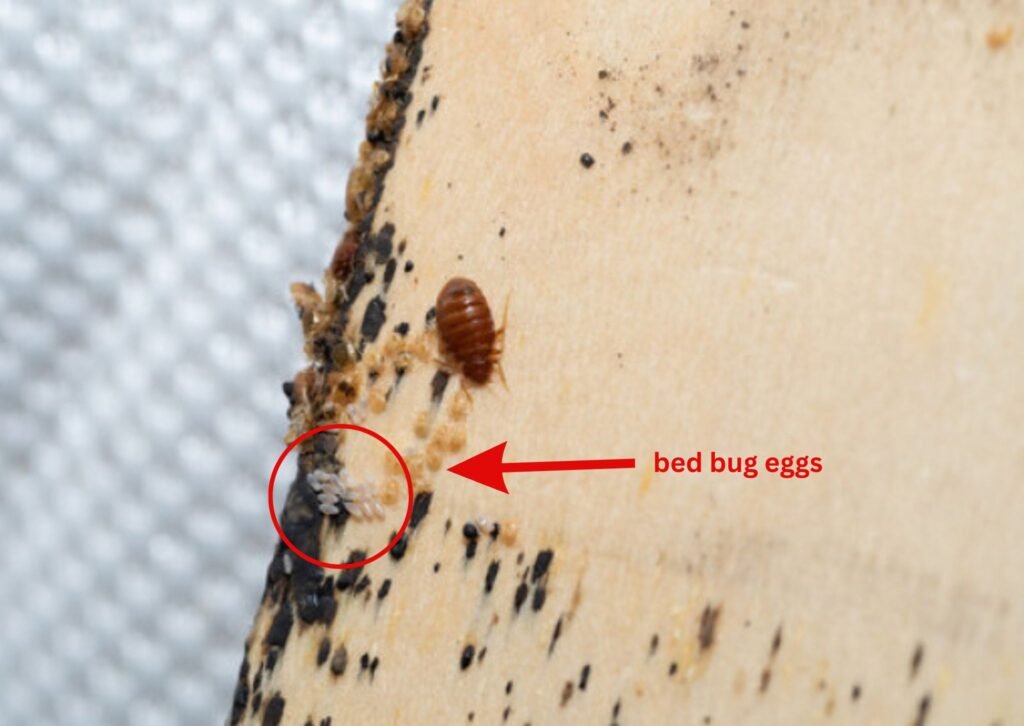
You can’t kill what you can’t see. Bed bug eggs are experts at hiding.
They are tiny, sticky, and blend right into light-colored sheets and furniture.
If you don’t know what you’re looking for, you might mistake them for a piece of dandruff or a crumb.
Let me show you exactly what to look for.
Physical Characteristics You Need to Know
Each bed bug egg measures approximately 1 millimeter in length, shaped like a grain of rice but even tinier.
They’re pearly white, smooth, and slightly reflective under light. Freshly laid eggs look glossy and translucent, while older ones turn matte and off-white as they age.
At one end of the egg is a faint seam line or “cap” — that’s where the baby bed bug, called a nymph, will pop out when it hatches.
If you see an egg with a little opening, it means a bed bug has already escaped.
Unlike lint, bed bug eggs are glued in place with a sticky secretion that hardens like glue.
They don’t roll, flake, or blow away when touched.
When you try to brush it away and it doesn’t move, then you’ll know it’s probably a bed bug egg.
Bed Bug Eggs vs. Other Common Pest Eggs
Many people mistake dust mites, carpet beetles, or cockroach eggs for bed bug eggs, but there’s a clear difference.
| Pest Type | Egg Size | Color | Texture | Location |
| Bed Bug | ~1mm | Pearly white | Smooth, sticky | Fabric seams, wood cracks, headboards |
| Dust Mite | Too small to see | Translucent | Not visible individually | Mattresses, pillows |
| Carpet Beetle | 1mm to 2mm | White to cream | Rough, loose | Under rugs, baseboards |
| Cockroach | 5mm to 10mm | Brown | Hard shell (capsule) | Warm, damp crevices |
The biggest clue is that bed bug eggs are typically found near where people sleep — never in kitchens, bathrooms, or food preparation areas.
If you see clusters in fabric seams or wood joints near your bed, you’re not dealing with beetles. You’re dealing with bed bugs.
Hatched vs. Unhatched Eggs — What to Look For
An unhatched egg looks full and plump — a perfectly sealed capsule with a moist shine.
A hatched egg resembles a tiny, empty shell with a hole at one end.
You’ll often find hatched and unhatched eggs mixed in clusters — a sign the infestation has been growing for a while.
That cluster tells you that some bed bugs have already hatched and are hiding in your room.
When you find these eggs, you must act quickly. You only have about a week before they hatch, and your problem gets much, much worse.
Where to Find Bed Bug Eggs: Your Room-by-Room Search Plan
Bed bug eggs aren’t spread all over your home. They’re clustered within a few feet of where you sleep or sit for long periods.
Females lay eggs in safe, tight spaces — places you’d never vacuum or wipe unless you were looking for them.
If you know where to look, you can find them. Here is your simple search plan.
Primary Hiding Spots — The Bedroom
This is the main battleground. Focus all your energy here first.
Most bed bug eggs are laid in proximity to sleeping areas, typically within several feet of the bed.
Look for egg clusters in these spots:
- Mattress seams: Pull back the thick stitching around the edges. Look for tiny white specks stuck in the folds.
- Box spring underside: Flip it over. Check the wooden frame and the cloth underneath. Bed bugs love to glue eggs along the wooden slats and around the plastic corner guards.
- Headboard and bed frame joints: Look in the cracks, screw holes, and where pieces of wood join together. This is a favorite hiding spot. Especially behind wall-mounted headboards.
- Bedside furniture: Check the undersides of nightstands, drawer slides, and screw recesses.
- Wall gaps behind the bed: Look at the baseboards and even behind the outlet covers near your bed.
Pro tip: Use a flashlight and an old credit card. Drag the card along a seam. If you see white specks that don’t brush away, that could be the glue from bed bug eggs.
Secondary Hiding Spots — Beyond the Bed
After the bed is full, the bed bugs spread.
They don’t travel far, but they do move to nearby furniture, fabric, and clutter. These are the secondary egg zones most people miss:
- Couches and recliners: Lift cushions and check zippers, folds, and seams — especially if you nap there.
- Curtains and drapes: Inspect the folds and stitching near the top hooks or rods.
- Closets and clothing: Bed bugs can lay eggs in seams of hanging clothes, especially if you’ve stored infested items after travel.
- Pet beds and carriers: Bed bugs don’t care about pets, but a pet’s bed is a warm, quiet place to lay eggs.
- Carpets and baseboards: Look at edges where carpet meets the wall; eggs can glue under tack strips.
If you live in an apartment or duplex, they may also appear along shared walls and electrical conduits. Bed bugs love the warmth behind outlets and light switches.
How to Conduct a Thorough Bed Bug Egg Inspection (Step-by-Step)
You don’t need high-tech gear or fancy tools; you just need a system. Here’s the correct inspection protocol:
- Gather Tools:
A bright flashlight, magnifying glass (or your phone’s macro camera), crevice tool, and lint roller. Optional: a steamer for confirmation — heat makes eggs pop if they’re real. - Start with the Bed:
Strip the sheets, inspect seams, lift mattress, and flip the box spring. Move slowly; look for white dots in clusters. - Move Outward:
Check bed frame joints, headboard, nightstands, curtains, and electrical plates within a 6-foot radius. - Inspect Sofas and Chairs:
Turn them upside down. Use the crevice tool to check where the fabric meets the frame. - Document What You Find:
Take clear photos. If you’re not sure it’s a bed bug egg, compare it to verified images online or show it to a pest control professional. - Use Traps and Monitors:
Place interceptor traps under bed and sofa legs. These help you gauge movement and confirm activity between treatments. - K-9 Confirmation (Optional):
A trained bed bug detection dog can find live eggs and adults behind walls and inside furniture — places you’ll never reach without ripping things apart. Professional inspections often use dogs before full treatments to pinpoint the source.
If you’ve found even one egg cluster, assume there are more within a 3–6 foot radius.
Bed bugs don’t lay one or two eggs; they lay hundreds over their short lives.
Missing just one cluster means a new infestation will start in a matter of days.
Now that you know how to find them, let’s talk about how to destroy them for good.
How to Destroy Bed Bug Eggs (Proven Methods That Actually Work)
Let’s be clear: you can’t just wish these things away.
Bed bug eggs are like tiny, sealed tanks. Their hard shell, called the chorion, protects them from most sprays and chemicals.
The only way to win is by using treatments that penetrate or destroy the shell — either through extreme heat, mechanical removal, or chemical action specifically designed for bed bugs.
You have four proven ways to do it. Let’s get started.
Method #1: Heat Treatment (Nature’s Most Reliable Killer)
Heat is the closest thing to a guaranteed kill. It doesn’t care about that protective shell.
Eggs die at sustained temperatures of 113°F (45°C); however, to be safe, you want a temperature of 130°F (54°C) or higher to be maintained for several hours.
Here’s the heat hierarchy:
- The Clothes Dryer:
This is your easiest weapon. Throw infested bedding, clothes, and fabrics in a dryer on high heat (140°F) for at least 30–40 minutes. That’s enough to cook every egg. - Steam treatments:
Use a professional-grade steamer that outputs at least 160°F (71°C) at the tip. Move it slowly — one inch per second — across mattress seams, couch folds, and baseboards. Steam penetrates fabrics and cracks where sprays can’t reach. - Whole-room heat treatment:
Professional pest control teams use industrial heaters to raise the entire room to 120–140°F for about 4–6 hours. It’s expensive, but it wipes out every life stage — egg, nymph, and adult. - DIY tip: Never use a hairdryer. Hairdryers are not recommended as they cannot maintain consistent lethal temperatures across large areas.
Why heat works: Proteins inside the egg denature (that’s science for “cook and collapse”), killing the embryo instantly. Nothing survives consistent heat exposure.
Method #2: Vacuuming (Mechanical Removal That Works When Done Right)
Vacuuming doesn’t kill eggs, but it physically removes them, and that’s half the battle.
Use a HEPA vacuum with a crevice tool attachment to target seams, joints, and corners for thorough cleaning.
Focus on:
- Mattress and box spring edges
- Bed frames and screw holes
- Baseboards and outlet perimeters
After vacuuming:
- Seal the bag in plastic immediately.
- Toss it in an outdoor trash bin.
- For bagless models, dump debris outside and rinse the canister with boiling water.
Note: Don’t rely solely on vacuuming. The sticky coating on eggs means some will resist suction, so pair this method with heat or residual sprays.
Method #3: Insecticides and Chemical Treatments (What Works and What to Avoid)
If you’re using chemicals, precision matters more than quantity. Most sprays kill adults but don’t kill bed bug eggs.
Use only EPA-registered bed bug products, as these are the ones proven to work on contact or through residual action.
- Desiccant Dusts (CimeXa, silica gel, diatomaceous earth):
These dry out newly hatched nymphs once they crawl through it. Apply light, even layers under baseboards, furniture edges, and outlet gaps. Lasts for weeks. - Residual Sprays (pyrethroids, neonicotinoids, chlorfenapyr):
These kill eggs indirectly by targeting hatchlings before they feed. Focus on cracks and crevices, not broad surfaces. - Insect Growth Regulators (IGRs):
Chemicals like hydroprene or pyriproxyfen disrupt the bed bug life cycle, stopping eggs from maturing.
The EPA advises against using foggers and bug bombs, as they often scatter bed bugs and rarely reach eggs or hidden areas. Most natural oils smell nice but lack lethal concentration.
Safety Tip: Keep children and pets out of the area during application and ventilate the rooms afterward. Always follow label instructions as bed bugs are nasty, but lung irritation is worse.
Method #4: Mattress Encasements (Starve What Survives)
Encasements don’t kill eggs directly; they trap them. Once sealed, bed bugs inside the encasement will starve to death over time.
Choose certified bed bug-proof encasements with:
- Microscopic zipper teeth
- Reinforced seams
- Full coverage (mattress + box spring)
Keep encasements on for at least 12–18 months. Bed bugs can live for over a year without feeding, so removing them early is like letting trapped bed bugs back into your home.
Encasements also make inspection easier — if you see new stains or spots outside the cover, you know new bed bugs are emerging.
Why Some DIY Methods Fail
The truth is, most internet “hacks” fail because they don’t reach the eggs or they don’t sustain lethal conditions
Here’s why some standard DIY methods fail:
- Essential oils: They smell nice, but kill nothing. Most don’t reach eggs or stay potent long enough.
- Foggers: They look dramatic but only hit exposed surfaces. Eggs inside seams laugh at foggers.
- Freezing: Home freezers don’t get cold enough. Eggs need to be kept at -4°F (-20°C) for several days to die.
- Alcohol sprays: Rubbing alcohol is flammable and poses fire hazards; the EPA does not recommend it for bed bug control due to safety risks and limited effectiveness.
DIY is fine for light infestations, but once eggs spread into furniture or walls, professional heat treatment is the only guaranteed reset.
Understanding the Bed Bug Life Cycle (Why Eggs Are Critical to Control)
Bed bugs live by one rule: multiply fast or die trying.
Every bite, every egg, every sleepless night runs on that one rule.
Crack that life cycle, and you stop the infestation. Ignore it, and it runs your life.
From Egg to Infestation — The Timeline
Here’s how it really works.
A female can lay 2 to 5 bed bug eggs every single day. In her short life, that’s up to 500 eggs, with each one ready to hatch in about 6 to 10 days if the room is warm.
When they hatch, the tiny bed bug nymphs are already hungry.
They feed within hours, then molt, feed again, and keep growing through five stages until they become full adults.
Under the right conditions, that entire bed bug life cycle — from egg to biting adult — takes only five or six weeks.
One pregnant bed bug hiding behind your baseboard today could become hundreds in less than two months.
Most people don’t understand the fact that the eggs don’t hatch all at once.
Females lay them daily, which means you’ve got multiple generations crawling around — some in eggs, some already feeding.
That’s why one pest control treatment is never enough. You kill one batch while the next is waiting to hatch.
If your follow-up treatments don’t hit that cycle on time, you’re just playing whack-a-mole with these bloodsuckers.
Why Bed Bug Eggs Are So Hard to Kill
Bed bug eggs are a tough nut to crack.
Nature gave them three unfair advantages that make them tough:
- Protective shell: The chorion is thick and waxy, blocking most liquid insecticides and water-based cleaners. It’s basically a biological raincoat.
- Adhesive coating: The mother bed bug glues each egg to seams and cracks. This makes them nearly impossible to vacuum or wipe away.
- Thermal tolerance: Eggs can survive short bursts of heat and cold, so inconsistent DIY treatments fail. Only sustained lethal temperatures (113°F or higher for 90 minutes or more) are effective.
Add to that the fact that you can’t see them from more than a foot away, and now you know why professionals often need multiple visits to finish the job.
The issue is that when those eggs hatch, the nymphs are almost invisible. You won’t see them, you’ll feel them.
To truly win this battle, your treatment must outlast the bed bug life cycle.
That means real heat, or chemicals that stay active long enough to hit every stage — eggs, nymphs, and adults.
Break the cycle, and you break the infestation.
Miss it, and you start all over again.
How Long It Takes Bed Bug Eggs to Hatch (And How to Time Your Treatments for Maximum Impact)
When it comes to killing bed bug eggs, timing is everything. Treat too early, and you waste energy. Treat too late, and you feed the enemy.
The entire success of your battle against bed bug infestation depends on understanding how long bed bug eggs usually take to hatch at normal room temperature (around 70°F – 80°F or 21°C – 27°C), which is approximately 6 to 10 days.
Here’s what that means for you:
In hot, humid rooms, those eggs can hatch in under a week. In cooler areas, they extend it to ten days or more.
But once they crack open, the new bed bug nymphs are starving. They’ll crawl out, find you, and feed within hours.
Miss one egg cluster, and you’ve just reset the bed bug life cycle all over again.
That’s why pest control professionals always schedule follow-up treatments after the first visit.
They hit in waves; each round timed to kill what just hatched before it can lay more eggs.
Here’s the smart schedule to follow:
- Day 1: Do your full cleanup like a professional — vacuuming, steaming, washing, and chemical application if using one.
- Day 7–10: Do a second round. This kills nymphs that hatched after the first treatment but haven’t laid eggs yet.
- Day 21: Optional third round for stubborn infestations. This is more like an insurance policy.
Follow that rhythm, and you’ll outpace their biology. You won’t just kill them, you’ll break the cycle completely.
One more thing: bed bug eggs can delay hatching when conditions aren’t ideal.
Research shows some eggs can “pause” development for up to 30 days in cool environments.
So even if your home feels pest-free after two weeks, don’t drop your guard just yet. Keep monitoring for another month.
To track progress, use interceptor traps under bed legs and along baseboards.
If you see new nymphs but no adults, it means eggs are still hatching somewhere. Continue the treatment.
Health and Safety Considerations for Families
Bed bugs can drive even the calmest people to lose their minds.
But the moment you start mixing random chemicals, sleeping in sealed rooms, or soaking your mattress in alcohol, you’re not fixing the problem – you’re creating a new one.
Bed bugs won’t kill you. Improper treatment might.
Are Bed Bug Eggs Dangerous?
No, they’re disgusting, not deadly.
Bed bug eggs do not transmit diseases or pose direct health risks. What they do is spread panic, lost sleep, and stress — because those eggs represent the next wave of attackers.
The real danger isn’t the eggs themselves but what they become.
Newly born bed bug nymphs bite fast. Those tiny vampires can leave you itching, breaking out in welts, or even dealing with infections from scratching.
And the stress doesn’t stop there — studies show that a bed bug infestation can cause sleepless nights, mood swings, and flat-out anxiety.
So no, the eggs themselves won’t hurt you. But ignoring them guarantees more bites, more stress, and more nights staring at the ceiling.
Safe Treatment Around Children and Pets
If you have kids, elderly relatives, or pets, you need to be cautious. Bed bugs are tough, but you’re still the one with opposable thumbs and a brain — so use them.
1. Start with the safe stuff.
Steam, dryers, and mattress encasements are 100% non-toxic. They should always be your frontline tools. No fumes, no chemicals, no risk.
2. Use only EPA-registered insecticides.
Check the label — it must explicitly say “for use on bed bugs.” These are tested for indoor safety when used as directed. Avoid black-market “bug bombs,” homemade pesticide cocktails, or agricultural-grade products. They do more harm than good.
3. Keep kids and pets out before spraying.
Even “safe” sprays contain active compounds that can irritate the lungs and skin. Ventilate the room well and wait until the treated surfaces are dry before allowing anyone to reenter.
4. Keep toys, dishes, and pet bedding sealed and washed.
Before treatment, bag or box everything that kids or pets touch daily. Wash their bedding and clothes in the dryer on high heat afterward.
5. Avoid residue build-up.
Spraying repeatedly without cleaning can cause chemical buildup. Wipe non-fabric surfaces with a mild soap and water mixture once the treatments are complete.
6. Don’t use essential oils directly on skin or pets.
They can cause burns or allergic reactions. Leave the peppermint and tea tree oil for your diffuser, not your dog. These essential oils don’t kill bed bug eggs.
You can win this fight without turning your house into a toxic zone and risking your health.
Use vacuuming, steam, and heat before resorting to chemicals.
Preventing Bed Bug Eggs from Returning (Post-Treatment Protection)
You’ve done the hard part — the steaming, vacuuming, washing, and maybe even professional heat treatment.
Now it’s time to build a permanent wall of defense. Bed bugs only return when we become complacent. The key is consistency, not paranoia.
Home Protection Checklist
This is your routine — short, repeatable, and deadly — to prevent bed bugs.
Weekly Tasks:
- Inspect sleeping areas: Check mattress seams, bed frames, and interceptors for new activity.
- Run dryer cycles: All bedding, pajamas, and curtains get a 30-minute high-heat spin, even if they look clean.
- Vacuum seams and baseboards: Use a crevice attachment and empty the vacuum outside.
Monthly Tasks:
- Steam touchpoints: Hit mattress edges, couch seams, and curtain folds with a slow steam pass.
- Reapply desiccant dust: Refresh CimeXa or diatomaceous earth under furniture and behind baseboards.
- Check encasements: Make sure zippers are intact and sealed tight.
Every 3–6 Months:
- Inspect furniture, wall outlets, and headboards for signs of fecal spots or bed bug eggs.
- Replace interceptor traps under bed legs.
- Schedule a professional inspection if you’ve had a serious infestation in the past.
You’re not cleaning anymore; you are on a mission to find and kill bed bugs.
Pet-Specific Prevention
Pets don’t attract bed bugs, but their beds and carriers make perfect egg nurseries. They’re warm, dark, and often ignored.
- Wash pet bedding weekly on the same high-heat cycle you use for your own.
- Vacuum around litter boxes and crates. Bed bugs hide in carpet fibers nearby.
- Inspect fabric toys and carriers. Anything soft that can’t handle heat should be sealed in plastic for 2–3 weeks to starve the bed bugs.
- If you travel with pets, keep their carriers off hotel floors. Instead, use hard surfaces or luggage racks.
Bed bugs won’t live on your pet, but they’ll happily use them as Uber rides.
When to Call a Professional Exterminator
If you’ve treated twice, cleaned everything, and still see fresh eggs or fecal spots, it’s time to bring in the big guns.
You need a professional exterminator if:
- You’re finding new eggs or live bed bugs 21 days after treatment.
- You’re seeing them outside the bedroom (living room, closets, baseboards).
- You live in an apartment or duplex with shared walls.
What to expect from pros:
- A full inspection using visual or K-9 detection.
- Integrated treatment: heat, chemical, and desiccant combo.
- Follow-up visits every 2–3 weeks until zero activity is confirmed.
Cost: Depending on your region, home size, and the severity of the infestation, professional treatments typically range from $1,000 to $3,000 for a whole-home heat treatment. However, they’re worth it if you’re losing sleep and sanity.
Pro tip: Pick a company that offers a re-treatment guarantee. If bed bugs return within 60 days, they will re-treat them at no additional cost.
You’ve earned peace of mind, but don’t slack off.
Prevention isn’t glamorous, but it’s what keeps your home clean, quiet, and bite-free.
FAQs About Bed Bug Eggs
You’ve done the research, ripped your bed apart, and maybe even lost sleep over it.
But there are still questions that keep you up at night, the kind that pop up right before you turn off the lights.
Let’s settle them once and for all.
How long can bed bug eggs survive without hatching?
At room temperature, bed bug eggs hatch in 6–10 days. When the temperature drops below 60°F (16°C), development slows down.
Some bed bug eggs can delay hatching for up to 30 days under cool conditions. They don’t die; they wait for the perfect conditions.
That’s why one round of bed bug treatment isn’t enough; you need to target every life stage over several weeks before it hatches.
Can you crush bed bug eggs?
Yes, but good luck finding them all.
They’re soft, so they’ll pop under a fingernail or tissue, but they’re glued deep in seams, cracks, and screw holes. Crushing a few you see doesn’t stop the hundreds you don’t.
If you really want control, pair it with vacuuming and heat treatment. That’s how you win.
What kills bed bug eggs instantly?
Only sustained heat does the job instantly. Expose them to 130°F (54°C) or higher, and they’re cooked in minutes.
Steam cleaners and dryers are your best tools for that.
Chemical sprays rarely kill eggs on contact; however, they’re effective against bed bug nymphs.
So, if you want immediate results, use heat.
Can bed bug eggs hatch inside sealed plastic bags?
Yes, but they won’t survive for long. Eggs can hatch inside sealed bags if there’s enough oxygen, but the nymphs die within days without food.
For safety, keep sealed items bagged for at least 2–3 weeks, or bake them at 140°F for 30 minutes to ensure they are dead.
How can I tell if bed bug eggs are dead?
Dead eggs appear dull, flattened, or brownish. Live ones are shiny, plump, and bright white.
After a heat treatment, check under a flashlight or magnifying glass.
If the eggs appear sunken or discolored, they’re done. If they still look pearly white, apply heat again.
Do bed bug eggs move or stick to your skin?
No. Bed bug eggs don’t move, crawl, or stick to skin. They’re glued to hard surfaces, not people or pets.
If you think you found eggs on your skin, it’s likely lint, dandruff, or scabs from bites. Bed bugs lay their eggs in hiding spots, not on you.
Can bed bug eggs survive washing or vacuuming?
Washing won’t kill bed bug eggs, but drying on high heat will. Bed bug eggs die after 30 minutes in a 140°F dryer cycle.
As for vacuuming, it removes many eggs but not all. Some are too well-glued to surfaces.
That’s why vacuuming is a cleanup step that should be followed with heat treatment or a residual spray.
Conclusion: Spot, Destroy, and Stay Bed Bug-Free
Bed bugs don’t quit. They don’t care how tired you are, how clean your house is, or how much you’ve already sprayed.
As long as bed bug eggs are hiding somewhere in your home, the battle isn’t over.
You can’t wish them away. You can’t “hope” the problem fades. It is either you kill them, or they come back.
The good news is that you now know their playbook. You know what bed bug eggs look like, where they hide, and how to destroy them with heat treatment, vacuuming, and consistency.
You’ve got everything you need to stop a bed bug infestation before it even starts.
Do it right, and you won’t just win, you’ll sleep in peace again. Do it halfway, and they’ll remind you every night what hesitation costs.
So, get ruthless.
Inspect. Steam. Seal. Repeat.
Don’t wait for another bite to “motivate” you. Every day you delay is another day those eggs get closer to hatching.
End it now, while you’re still ahead.
Because with bed bugs, you don’t get second chances. You get bitten.